April 2018

Austin ISD Police Department

Austin ISD Police Department

Mission Statement: The Officers of the Austin ISD Police Department are committed to creating a safe educational environment and protecting our future by providing a diverse level of service, utilizing problem solving techniques, and embracing lasting partnerships for all students, staff, and the community.

The Austin ISD Police Department employs 82 full-time police officers, including 43 School Resource Officers (SROs), 8 Patrol Officers and, 4 Detectives. There are two SROs assigned to every high school campus and one SRO assigned to every middle school campus. The Patrol Officers primarily assist with calls for service and safety patrols at our elementary campuses, and supplement our secondary campuses as needed.

The department also employs ​15 civilian staff, including dispatchers, office support staff, evidence technicians, and data clerks. The department provides general law enforcement, security and safety services for Austin ISD year-round, and establishes strong working relationships with Austin area first responder agencies to provide the safest environment for our students, staff, and stakeholders.

With the introduction of Texas House Bill 3 on September 1st, 2023, the Austin ISD School Board voted to hire additional Austin ISD Police Officers in order to comply with the law.  This includes Austin ISD Police Officers who will be assigned to all campuses across the District where students are present, along with the additional sworn and non-sworn staff needed to support them.  As such, the Austin ISD Police Department is currently hiring for multiple positions, and encourage those interested to visit our Recruitment page or contact our Recruiting Division at 512-414-1129, or recruiting@austinisdpolice.org

Budget

Austin ISD Finance Accolades

Finances at Austin ISD

Austin ISD is committed to maintaining a transparent budgeting process. The budget is driven by the AISD strategic plan, which is the product of genuine consensus‐building and embodies the vision of our community. The AISD board of trustees established a policy that requires the district to maintain a minimum of 20 percent of operating expenditures in its general fund balance, which is also a driving factor in the budgeting process.

Austin ISD has earned the highest ratings for budget management from Moody’s Investors Service, Standard & Poor’s, Kroll Bond Rating Agency and Fitch Ratings. Austin ISD also carries the highest bond and state financial accountability ratings that school districts can earn in the state of Texas.

Maintaining transparency about the AISD budget includes providing financial information to the public. On this site, you will find a host of resources, including data on district revenues, expenditures, tax rates, cost drivers and comparative data with other school districts.

Get involved in the 2024–25 budget planning process >

How is the Austin ISD budget funded?

The majority of the district’s funding is derived from local property taxes, supplemented by state and federal sources.*

The Texas Legislature establishes the funding formulas for public schools, with allocations primarily based on two key factors:

  • Average Daily Attendance (ADA) and the district’s property tax collections; and 
  • Additional weighted funding for specific student populations, including those eligible for State Compensatory Education services (such as students identified as at-risk or economically disadvantaged), as well as students receiving Special Education services.

*Austin ISD is subject to a state-mandated process known as "recapture," which requires a portion of locally collected property tax revenue to be remitted to the State of Texas.


 Why is Austin ISD facing a budget deficit?

 Each year, Austin ISD’s expenses increase due to rising costs such as property insurance, energy, fuel, and staff raises to align with the rising cost of living. At the same time, state funding for Texas schools has remained relatively stagnant since 2019. Additionally, federal funding has been reduced due to a decline in the economically disadvantaged student population. Federal reimbursements for School Health and Related Services, which largely fund special education therapies, have also decreased.

During the 88th Texas legislative session in 2023, school districts across Texas alerted the public and legislators of the urgent need for the state to increase school funding given these rising costs and unfunded mandates like the HB3 that requires districts to staff an armed officer at every campus.

Despite the growing need for additional school funding, no new school funding resulted from the regular legislative session, or from any of the four special sessions Texas Governor Greg Abbott called in 2023.

  • At the time, Governor Abbott stated he would only approve school funding increases if some form of voucher bill became law.
  • A bipartisan coalition of legislators stood against Governor Abbott’s push for vouchers because they opposed diverting taxpayer dollars to private education.
  • As a result, several bills, which contained provisions for teacher compensation and school safety funding, were not passed, leaving school districts statewide with stagnant budgets that have not been adjusted to account for costs due to inflation.

The Texas Legislature meets every two years with the 89th legislative session currently underway.


Why does Austin ISD have budget challenges when school funding comes from local property tax revenue and local property tax bills have been rising each year?

While Austin has experienced significant economic growth, Austin ISD does not get to keep the majority of the property tax revenue that comes with that growth. This is because of a state mandate called recapture, which requires school districts considered “property wealthy” — like Austin — to send money back to the state to support “property poor” school districts.


How can I provide feedback to the district or ask a question to the district?

There’s many ways to provide feedback. Join us for a community meeting or share your feedback on AISD Help! AISD Help is a platform that allows community members to submit questions or provide feedback on any topic of interest. It can be accessed through the Austin ISD website by clicking the AISD Help! button located next to the search bar, or by clicking this link austinisd.org/aisdhelp.


FY 2024-25 Budget FAQs

What opportunities are there for the community to provide input on the budget?

Austin ISD hosts a series of budget community conversations every year during the spring semester. Community members can get involved by attending those meetings and also by being part of their Campus Advisory Council (CAC), which works with principals to provide input on campus budgets.
 

What is Austin ISD’s expected budget shortfall for the 2024-25 school year?

The Austin ISD school board adopted a budget with a $78 million shortfall for the 2024-25 school year with a commitment from the administration to keep reducing spending throughout the fiscal year. Since then, despite continuous spending reductions and the approval of Prop A by Austin taxpayers, the deficit has grown to a projected $110 million due to declining property values and growing inflation. Additionally, Austin ISD has incurred expenses that were not initially budgeted for, such as Special Education contracted services and maintenance and repairs. 


What is Austin ISD Doing to reduce the budget deficit? 

The district has already reduced its 2024–25 budget by approximately $60 million. These reductions include the elimination of Central Office positions, scaling back of service contracts, and implementing operational efficiencies across the organization. A districtwide hiring freeze—excluding positions in special education—was enacted effective March 1, 2025, as a cost-saving measure for the current fiscal year.

Additionally, the district has significantly reduced spending associated with procurement card (P-Card) usage and has implemented a process requiring pre-approval of purchase orders, check requests, and both employee and non-employee reimbursements before any expenditures.


How do property values and recapture factor into the budget?

The adopted budget for the 2024–2025 school year includes $1.57 billion in local property tax revenue collected by Austin ISD. Of that amount, the district is projected to send $940 million of local property tax revenue to the state to fund other school districts. As of April 9, 2025, the Travis County Appraisal District released preliminary property value estimates. Please note that final certified values will not be released until July 2025.


How much of the Austin ISD budget is allocated to staff compensation?

After recapture, 89% of Austin ISD’s General Fund is allocated toward payroll-related costs.


FY 2025-26 Budget FAQs

When will the budget be final?

The preliminary budget for the 2025-26 school year will be presented to the Austin ISD Board of Trustees in April. No decisions will be made until the Board votes to approve the proposed budget on June 26, 2025. If approved, the budget will take effect on July 1, 2025.


What is Austin ISD’s expected budget shortfall for the 2025-26 school year?

The district is currently projecting a budget deficit ranging from $110 million to $123 million for the 2025–26 school year, based on preliminary property value estimates the district will receive from Travis Central Appraisal District (TCAD) on April 9th. 


How much of the Austin ISD budget is allocated to staff compensation?

After recapture, 89% of Austin ISD’s General Fund is allocated toward payroll related costs. 


What is Austin ISD doing to reduce the budget deficit?

We’ve identified roughly $20 million in potential savings by streamlining class schedules, reworking bus routes, reevaluating contracts, tightening staff allocations at smaller campuses and eliminating underused software. While every effort has been made to keep reductions away from the classroom, the growing deficit means that we have to start looking at reductions that will have a direct impact on campuses. This might mean consolidating classes or positions to streamline campus schedules, understanding this could impact class sizes and programs. Non-mandatory programs and partnerships are also under review for possible reduction or elimination, though further engagement will be needed before making any decisions.

At this time, the Board has initiated discussions regarding the potential consolidation of schools.

Additionally, the district is working to monetize underused properties. The Board has already designated several former school campuses as surplus, creating the opportunity to lease or sell them.

¿Cómo se financia el presupuesto del Austin ISD?

La mayor parte del financiamiento del distrito proviene de los impuestos locales sobre la propiedad, suplementándose con fuentes estatales y federales.*

La Legislatura de Texas establece las fórmulas de financiamiento de las escuelas públicas, con asignaciones que se basan principalmente en dos factores clave:

  • Asistencia diaria promedio (ADA, por sus siglas en inglés) y las recaudaciones de impuestos sobre la propiedad del distrito; y
  • Financiamiento adicional ponderado para poblaciones específicas de estudiantes, incluyendo aquellos elegibles para los servicios de Educación Compensatoria Estatal (como los estudiantes identificados como en riesgo o con desventaja económica), así como los estudiantes que reciben servicios de educación especial.

*El Austin ISD está sujeto a un proceso obligatorio estatal conocido como “recuperación”, que requiere que una parte de los ingresos recaudados localmente por el impuesto a la propiedad se remitan al Estado de Texas.

¿Por qué enfrenta el Austin ISD un déficit presupuestario?

Cada año, los gastos del Austin ISD aumentan a causa de los crecientes costos, como el seguro de la propiedad, la electricidad, el combustible y los aumentos para el personal para alinearse con el aumento del costo de vida. Al mismo tiempo, el financiamiento estatal para las escuelas de Texas se ha mantenido relativamente estancado desde 2019. Además, el financiamiento federal se ha reducido debido a una disminución en la población estudiantil con desventaja económica. Los reembolsos federales para Salud Escolar y Servicios Relacionados, que financian en gran medida las terapias de educación especial, también han disminuido.

Durante la 88.ª sesión legislativa de Texas en 2023, los distritos escolares de todo Texas alertaron al público y a los legisladores de la urgente necesidad de que el estado aumente la financiación de las escuelas dados estos crecientes costos y órdenes no financiadas como el HB3 que requiere que los distritos escolares tengan un oficial armado en cada escuela.

A pesar de la creciente necesidad de financiamiento escolar adicional, no se obtuvo ningún aumento en el financiamiento escolar en la sesión legislativa ordinaria ni en ninguna de las cuatro sesiones especiales que convocó el gobernador de Texas Greg Abbott en 2023.

  • En ese momento, el gobernador Abbott dijo que solo aprobaría los aumentos en el financiamiento escolar si algún tipo de vales se convertía en ley.
  • Una coalición bipartita de legisladores luchó contra la presión del gobernador Abbott por los vales, porque se oponían a desviar el dinero de los contribuyentes de impuestos hacia la educación privada.
  • Como resultado, varios proyectos de ley que incluían financiamiento para la compensación de maestros y la seguridad escolar no se aprobaron, dejando a los distritos de todo el estado con presupuestos estancados que no están ajustados al costo de la inflación.

La Asamblea Legislativa de Texas se reúne cada dos años, y actualmente se está celebrando la 89.ª sesión legislativa.

¿Por qué el Austin ISD tiene problemas presupuestarios {dificultades presupuestarias] cuando el financiamiento de las escuelas proviene de los ingresos locales de impuestos a la propiedad y las cuentas de impuestos locales a la propiedad han estado aumentando cada año?

Aunque Austin ha tenido un crecimiento económico significativo, el Austin ISD no conserva la mayor parte de los ingresos por los impuestos sobre la propiedad provenientes de ese crecimiento. Esto es a causa de una orden estatal llamada recuperación, que requiere que los distritos escolares que se consideran “ricos en propiedades” (como Austin) envíen dinero al estado para apoyar a los distritos escolares “pobres en propiedades”.

¿Cómo puedo dar mi opinión al distrito o hacerle una pregunta?

RHay muchas formas de dar su opinión. Únase a nosotros en una reunión comunitaria o comparta su opinión en AISDHelp! AISD Help es una plataforma que permite a los miembros de la comunidad enviar preguntas o comentarios sobre cualquier tema de interés. Se puede acceder a través del sitio web del Austin ISD haciendo clic en el botón AISD Help! ubicado junto a la barra de búsqueda, o haciendo clic en este enlace austinisd.org/aisdhelp.


Preguntas frecuentes sobre el presupuesto del AF 2024-25

¿Qué oportunidades hay para que la comunidad dé su opinión sobre el presupuesto?

El Austin ISD tiene una serie de conversaciones comunitarias sobre el presupuesto cada año durante el semestre de primavera. Los miembros de la comunidad pueden participar asistiendo a esas juntas y también formando parte de su Consejo Consultivo Escolar (CAC, por sus siglas en inglés), que trabaja con los directores para proveer opiniones sobre los presupuestos escolares.

¿Cuál es el déficit presupuestario del Austin ISD esperado para el ciclo escolar 2024-25?

La mesa directiva del Austin ISD adoptó un presupuesto con un déficit de $78 millones para el ciclo escolar 2024-25 con el compromiso de la administración de seguir reduciendo los gastos a lo largo del año fiscal. Desde entonces, a pesar de continuas reducciones en los gastos y la aprobación de la Propuesta A por parte de los contribuyentes fiscales, el déficit ha aumentado a $110 millones debido a la disminución del valor de la propiedad y a la creciente inflación. Además, el Austin ISD ha incurrido en gastos que no estaban presupuestados inicialmente, como los servicios contratados de educación especial y el mantenimiento y las reparaciones.

¿Qué está haciendo el Austin ISD para reducir el déficit presupuestario?

El distrito ya ha reducido aproximadamente $60 millones del presupuesto en el ciclo escolar 2024-25. Estas reducciones incluyen la eliminación de puestos en las oficinas centrales, la reducción de contratos de servicios y la implementación de eficiencias operacionales en toda la organización. A partir del 1.° de marzo se implementó una congelación de contrataciones en todo el distrito, excluyendo al personal de educación especial, como medida para reducir los gastos del año fiscal actual.

Además, el distrito ha reducido significativamente el gasto asociado con el uso de la tarjeta de compras (P-Card) y ha implantado un proceso que requiere la aprobación previa de las órdenes de compra, las solicitudes de cheques y los reembolsos tanto a empleados como a personas que no sean empleados antes de cualquier gasto.

¿Cómo influyen en el presupuesto el valor de la propiedad y la recuperación?

El presupuesto adoptado para el ciclo escolar 2024-2025 incluye $1,570 millones en ingresos por impuestos locales a la propiedad recaudados por el Austin ISD. De esa cantidad, se proyecta que el distrito envíe $940 millones de ingresos por impuestos locales a la propiedad al estado para financiar a otros distritos escolares. A partir del 9 de abril de 2025, el Distrito de Tasaciones del Condado de Travis publicó estimaciones preliminares del valor de la propiedad. Tenga en cuenta que los valores finales certificados no se publicarán hasta julio de 2025.

¿Cuánto del presupuesto del Austin ISD se asigna a la compensación del personal?

Después de la recuperación, el 89% del fondo general del Austin ISD se asigna a costos relacionados con la nómina.


Preguntas frecuentes sobre el presupuesto del AF 2025-26

¿Cuándo se tendrá el presupuesto final?

El presupuesto preliminar para el ciclo escolar 2025-26 se presentará a la mesa directiva del Austin ISD en abril. No se decidirá nada hasta que la mesa directiva haga una votación para aprobar el presupuesto propuesto el 26 de junio de 2025. Si se aprueba, el presupuesto entrará en vigor el 1.o de julio de 2025.

¿Cuál es el déficit presupuestario del Austin ISD esperado para el ciclo escolar 2025-26?

Actualmente, el distrito está pronosticando un déficit estimado que va de $110 millones a $123 millones para el ciclo escolar 2025-26 con base en las estimaciones preliminares del valor de la propiedad que el distrito recibirá del Distrito de Tasación Central de Travis (TCAD, por sus siglas en inglés) el 9 de abril.

¿Qué está haciendo el Austin ISD para reducir el déficit presupuestario?

Hemos identificado aproximadamente $20 millones en posibles ahorros al optimizar los horarios de clases, reorganizar las rutas de autobús, reevaluar los contratos, ajustar las asignaciones de personal en escuelas más pequeñas y eliminar el software infrautilizado.

Aunque se ha hecho todo lo posible por mantener las reducciones al margen de los salones de clases, el creciente déficit significa que tenemos que empezar a buscar reducciones que tendrán un impacto directo en los planteles escolares. Esto podría significar consolidar clases o puestos para optimizar los horarios escolares, entendiendo que esto podría afectar el tamaño de las clases y programas. Los programas y colaboraciones que no son obligatorios también se están revisando para su posible reducción o eliminación, aunque será necesaria una mayor participación comunitaria antes de tomar cualquier decisión.

En este momento, la mesa directiva ha iniciado conversaciones sobre la posible consolidación de las escuelas. Además, el distrito está trabajando para rentabilizar las propiedades infrautilizadas. La mesa directiva ya ha designado varios antiguos planteles escolares como excedentes, creando la oportunidad de arrendarlos o venderlos.


2024-25 Budget Progress


2025-26 Budget Progress


Austin ISD Financial Accolades

Four AAA Bond Ratings

Austin ISD became the first Texas School District to earn four AAA bond ratings. This rating is the highest a school district can achieve. The rating indicates the lowest risk of default and makes sure the district will get the lowest interest rates when taking on debt.

KBRA Rating Letter
KBRA Austin ISD Series 2025 Rating Report

Excellence in Financial Reporting

Awarded the Government Finance Officers Association (GFOA) “Certificate of Achievement for Excellence in Financial Reporting” for thirteen consecutive years.


Risk Management Fund Excellence

Awarded the "Risk Management Fund Excellence" from the Texas Association of School Boards.

Meritorious Budget Award

Awarded the Association of School Business Officials (ASBO) “Meritorious Budget Award."


Excellence in Financial Reporting

Awarded the Association of School Business Officials (ASBO) “Certificate of Excellence in Financial Reporting” for fourteen consecutive years

Superior Achievement Rating from TEA

For the 21st consecutive year, the district earned a “Superior Achievement” rating from the TEA. This is the highest possible rating under the Schools FIRST financial accountability system.


Facilities and Bond Planning Advisory Committee

Notice: This Committee is Currently Inactive

Facilities and Bond Planning Advisory Committee (FABPAC) Inactive as of December 3, 2020


Committee Charge

Section One. Purpose. The Board of Trustees appoints citizens to the Facilities and Bond Planning Advisory Committee (FABPAC) to evaluate capital improvement needs of the district and to provide recommendations to the Board of Trustees on long-range facilities planning; amendments to the Facility Master Plan; and the scope of work and timing of future bond programs.

Section Two. Responsibilities. To accomplish its purpose, the Committee shall have the following responsibilities:

  • Provide recommendations on long-range facilities planning and amendments to the Facility Master Plan;
  • Evaluate current use of district facilities and review critical needs, including overcrowded and under enrolled schools;
  • Evaluate technology, transportation and unmet facility needs;
  • Refer potential boundary changes needed to optimize the use of district facilities to the Boundary Advisory Committee for consideration;
  • Engage the community in dialogue regarding long-range facilities and capital improvement needs in support of the district's strategic plan;
  • Assist district-wide community outreach efforts to increase public awareness of the facilities planning process, capital improvement plans and proposed bond programs;
  • Develop recommendations for long-range capital improvement needs;
  • Develop facilities modernization plans;
  • Evaluate tax impact and long-term investments of taxpayers; and
  • Develop recommendations for the scope of work for potential future proposed district bond program(s).

Contact Information

Melissa Laursen, AICP
Director of Planning
4000 S. IH 35 Frontage, 4th Floor
Austin, TX 78703-5338
Office: 512-414-8942
Fax: 512-414-4009
Email

Career and Technical Education Advisory Committee

The Career and Technical Education Advisory Committee provides assistance to and promotes the development of Career and Technical Education programs to meet the needs of students, business and industry and the community.

To accomplish its purpose, the CTEAC provides collaborative opportunities and expertise to educators and AISD administration on matters related to CTE programs. The responsibilities of the CTEAC include:

  • Public relations
  • Curriculum
  • Community resources
  • Student organizations
  • Job placement
  • Staff development
  • Program review and evaluation
  • Legislation

CTEAC Bylaws

To become a CTE Advisory member or for more information about scheduled meetings during the 22-23 school year email jordan.spears@austinisd.org

CTEAC 2025–26 Membership

To apply for membership, please complete and submit the standard application form: English / Spanish

Budget and Finance Advisory Committee

Notice: This Committee is Currently Inactive

Budget and Finance Advisory Committee

The Budget and Finance Advisory Committee provides guidance and counsel to Austin ISD administration. The scope of the BFAC’s advisory capacity includes:

  • Annual schedule for budget development and approval
  • Planning and conducting stakeholder engagement activities, and gathering and assessing stakeholder input
  • Development and review of proposed budgets
  • Alignment of proposed budgets with the district’s strategic plan
  • Budgetary efficiencies and cost-savings
  • Budget and finance implications to staffing, facilities and operations
  • Evaluation of programs and initiatives in terms of performance and cost effectiveness for the purpose of determining appropriate budgetary investments
  • Best practices in school district budget and finance
  • District financial ratings
  • Local property tax rates
  • Financial development and alternative forms of finance
  • State and federal school financing and district legislative agenda
  • Transparency and accessibility of data, information and technology

BFAC bylaws

BFAC 2018–19 membership

Community Bond Oversight Committee

Community Bond Oversight Committee

The Board of Trustees appointed volunteer community members to the Community Bond Oversight Committee (CBOC) to ensure that the projects remain faithful to the voter-approved bond program scope of work and to monitor and ensure the bond projects are completed on time, with quality and within budget. 


The CBOC Charge  


Section One. Purpose – The Board of Trustees appoints individuals to the CBOC to ensure that bond projects remain faithful to the scope of work approved by district voters. All bond-funded projects are within the committee's oversight responsibilities.


Section Two. Responsibilities –To accomplish its purpose, the CBOC shall have the following responsibilities:

  1. Providing oversight of the district bond programs, including:
    1. Overall budget status;
    2. Scope, quality and schedule;
    3. Program surplus and contingency funds;
    4. Stakeholder satisfaction;
    5. HUB utilization;
    6. Any proposed substantive changes;
    7. Issues and risks; and
    8. Communication strategies and methods.
  2. Providing on an annual basis a written or oral report to the Board of Trustees summarizing the status of the bond program, any issues of concern, and any recommendations for corrective action. The committee may provide additional briefings, memos and other communications to the Board of Trustees as needed.
  3. Reviewing information from staff on expenditures of bond funds, and on the timelines and progress of the bond programs.
  4. Working with staff to gauge, through surveys or other means, the levels of satisfaction of key campus and community stakeholders with the quality of work and customer service.
  5. Evaluating any proposed changes to the overall bond program, such as additions or deletions of projects, and making recommendations to the Board of Trustees about further action.
  6. Working with staff to make recommendations to the Board of Trustees on the use of program-level surplus funds.

Advisory Bodies

What Are AISD Advisory Bodies?

The Austin Independent School District values the participation and input of all community members and transparency of information and process. To that end, the district has established several advisory bodies consisting of broad stakeholder representation to provide insight and recommendations on important issues.

These advisory bodies may be called task forces, committees, or councils. Some of them are standing bodies and meet permanently on a regular basis, while some of them are ad hoc or periodic bodies and meet for a limited time to address a specific topic. Selection entities for advisory body memberships may include Trustees, the Superintendent, the administration, or the advisory bodies themselves.

Below is a list of current AISD advisory bodies, all of which have their own websites. To learn more about specific AISD advisory bodies, please use the links provided.

To find out if a particular committee currently has any vacant positions, please refer to the membership lists provided on each committee website.

Austin ISD is now accepting applications for nomination to the TCAD Board of Directors.

To be considered, you must complete the  Application Form in its entirety by September 30, 2025.

The TCAD is responsible for determining the value of all real and business personal property within Travis County, Texas. The TCAD Board of Directors typically meets on one Thursday each month at 11:30 a.m., unless otherwise designated by the Board. Meetings are held at TCAD offices located at 850 E. Anderson Lane, Austin, Texas 78752.

Five members of the TCAD Board of Directors are appointed by the taxing units served by the District and three members are elected by the majority at large.  The Tax Assessor Collector also serves as a member of the Board of Directors. The TCAD Board selects a chief appraiser, the Taxpayer Liaison Officer, and the TCAD Board general counsel. The TCAD Board also adopts the annual TCAD budget and ensures that the Appraisal District follows policies and procedures and appropriate state laws and regulations. The Property Tax Assistance Division of the Comptroller’s office provides a full publication on the responsibilities of the CAD Board of Directors.  TCAD Board does not appraise property, hear protests, or make decisions affecting appraisal records. For more information, visit the TCAD website.

To apply for membership on an AISD Advisory Committee, please complete and submit the standard application form: English / Spanish

Overview of Advisory Bodies

Resumen general sobre los cuerpos consultivos del distrito

Communication and Visitor Guidelines

Pautas para las comunicaciones y los visitantes 

Standing Advisory Bodies

(Standing advisory bodies meet permanently on a regular basis.)

Advocacy Advisory Committee (AAC)
Campus Advisory Councils (CAC)
Career and Technical Education Advisory Committee (CTEAC)
Community Bond Oversight Committee (CBOC)
District Advisory Council (DAC)
Equity Advisory Committee (EAC)
Environmental Stewardship Advisory Committee (ESAC)
Head Start Policy Council (HSPC)
Multilingual Education Advisory Committee (MEAC) 
School Health Advisory Council (SHAC) 
School Safety and Security Committee (SSSC)
Special Education Family Advisory Committee (SEFAC)

Ad Hoc/Periodic Advisory Bodies

(Ad hoc advisory bodies are formed for a particular purpose and meet for a limited time, and are discontinued when their work is completed. Periodic advisory bodies are also formed for a particular purpose, but on a recurring basis as needed.)

Currently Active

Ad Hoc Community Budget Committe
Innovation District Advisory Committee (IDAC)

Currently Inactive

Bond Steering Committee (BSC)
Brooke Art Transition Taskforce
Budget and Finance Advisory Committee (BFAC)
Budget Stabilization Task Force (BSTF) 
Calendar Task Force
Diversity by Design Steering committee (DDSC)
Facilities and Bond Planning Advisory Committee (FABPAC)
Long-range Planning Committees (LPC)
School Renaming Task Force (SRTF)
Special Education Advisory Committee (SEAC)
Student Equity Council (SEC)

Economic Opportunity Office

Economic Opportunity Office Mission

To provide opportunities for local businesses that will broaden and enhance their capacities to participate on District procurement contracts which will stimulate economic growth in the community.

The Austin ISD Economic Opportunity Office (EOO) provides:

  • A program that encourages local participation in all phases of procurement.
 

The Economic Opportunity Office Has Some Updates!

Join us for Thought Provoking Thursday on October 30th from 9:00AM to 10:00AM to learn how to complete the updated HUB Utilization Report.

Register here

Not able to make it? No problem, we will also be offering weekly office hours through November 20th

Register here for one of our office hour trainings.


We Encourage Feedback

To provide feedback about the AISD Economic Opportunity Office, or for outreach assistance call (512) 414-3120.

Facility Master Plan

Facility Master Plan

In April 2017, the Board of Trustees adopted a 25-year Facility Master Plan, which informed the development of a $1 billion bond investment approved by voters to modernize schools and create learning spaces worthy of our students’ talents as they prepare for an ever-changing global marketplace. The FMP calls for a minor update every two years, and a major update every five years.

The FMP was driven by seven Board-approved guiding principles:

  • Health, Safety, & Security
  • Academics & Co0curricular Supports
  • Protection of Financial Investment
  • Optimal Utilization
  • Equity in Facilities
  • Environmental Stewardship & Sustainability
  • Communication & Community Engagement

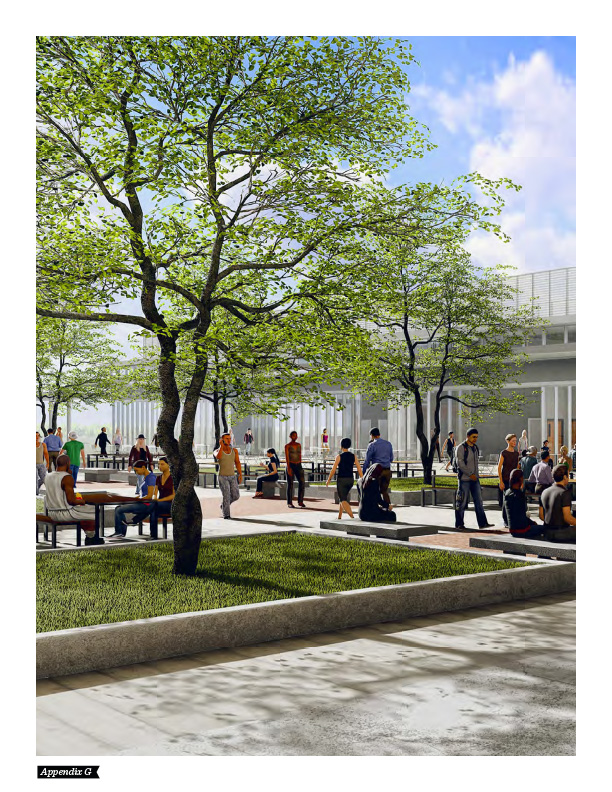
In January 2020, the Board of Trustees adopted an update to the FMP that included a portable management and reduction strategy, and changes to the optimal utilization range Appendix G.

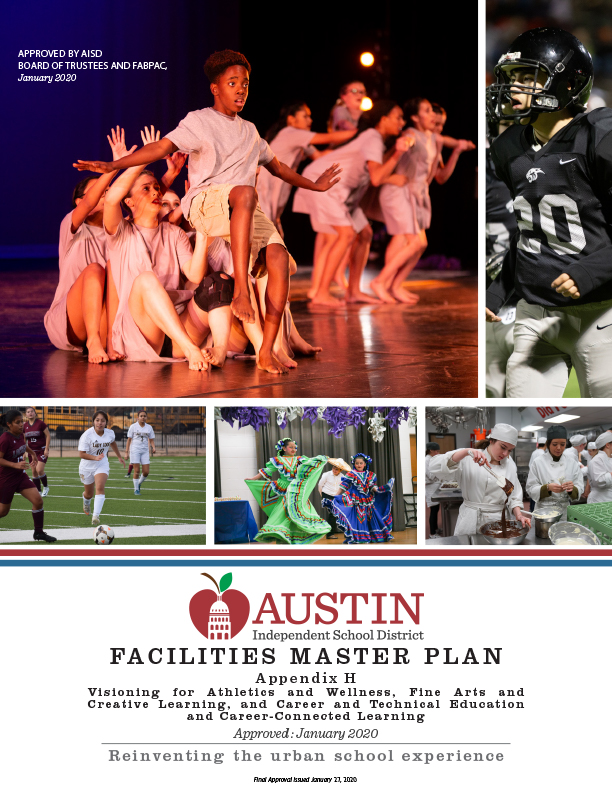
Additionally, Appendix H of the 2019 Facilities Master Plan  creates a new vision for Athletics and Wellness, Fine Arts and Creative Learning, and Career and Technical Education and Career-Connected Learning that will

  • provide equity for all learners through consistent program offerings;
  • identify cross-curriculum opportunities across all three disciplines;
  • promote strong relationships with local partners; and
  • improve the overall student experience through the design and planning of flexible and adaptable spaces.

We believe that these areas long thought of as extra activities are essential for our students to grow into well rounded individuals prepared for college, career and life.

Not only do these programs promote social and emotional growth, but our research has shown that academics are also positively affected by participation in them. Our Department of Research and Evaluation found:  

  • CTE students enrolled at two- and four-year colleges at higher rates than their counterparts who did not participate in CTE courses.
  • Student athletes outperformed their peers who were not in athletics on state academic assessments by as much as 14 percentage points in middle school and seven percentage points in high school.
  • Of teachers who use Creative Teaching techniques, 94% reported that using Creative Teaching engaged their students and over half reported seeing that it helped their students retain content.

This means we need to provide an opportunity for every student to thrive in one or all of these pathways.


Our Vision of the Future

Athletics and Wellness 

Our goal is to:

  • provide equitable geographic access; 
  • bring equity in terms of course offerings and student opportunities;
  • improve the overall health and wellness of students, staff and spectators; 
  • and ensure that operations, scheduling, and transportation are provided efficiently throughout the District.

Fine Arts and Creative Learning 

Our goal is to:

  • provide equal access to all programs throughout the District;
  • implement a plan that addresses current spatial inequities at each campus; and,
  • through Creative Learning, use research-based Creative Teaching strategies to enhance students’ learning at all campuses.

Career and Technical Education and Career-Connected Learning

Our goal is to:

  • offer current and additional programs and student opportunities in an equitable, financially feasible, and logical manner;
  • provide specialized CTE and Career Launch opportunities regionally at identified high school campuses;
  • evaluate current and future partnerships to ensure that the District is providing the best possible opportunities for its students;
  • and implement policies which ensure that operational items are as efficient as possible.

Facility Master Plan Documents and Appendices A-H


Contact Information

Beth Wilson 
Executive Director of Planning and Asset Management 
512-414-9841
beth.wilson@austinisd.org

Melissa Laursen
Director of Planning 
512-414-8942
melissa.laursen@austinisd.org